The online world now delivers, second by second, commentaries on everything and every picture, movie, or piece of information. Anyone who travels today and unavoidably in the media sea, whether on an ideological aircraft carrier or completely on his own in a private nutshell, is confronted with the fact that, at least at first glance, there is hardly a shore or a harbor where the psyche can come to its senses. That is, the possibility not only of consuming information, which is child’s play today, but also of really processing it. Which is a real challenge
Like muscle building, which does not take place during training, but in the regeneration phase—very old hat for sports scientists—the development of consciousness also needs rest breaks from constantly inflammatory stimuli in order to exploit the real potential of psychic and mental vitality. This is also nothing new; meditation, for example in Zen Buddhism or the classic walk in the park or forest, aims precisely at this healing psychological decoupling from the hamster wheel of everyday life.
But there is also an extremely refined artistic tradition, particularly appreciated in the West, that does not rush from moment to moment at the very first glance: painting. In contrast to film, which technically consists of presenting very fast-moving, imperceptibly separate individual images to the eye, or music, the theater, or the novel, where sounds, dramas, or stories unfold over time and hardly allow one to linger in one place, the flow of time in painting actually visibly comes to a halt. The traditional picture does not move, but rests in itself, completely independent of what is representation or portrayed.
In fact, the picture, simply as a medium, conveys although not the whole, yet a very important message: to be able to get in touch with it at all, attention must be completely focused on the picture at least for a moment. One cannot devote oneself to an image en passant, because without an at least temporary perceptual immersion, it would not appear at all in consciousness as reality. It would then be some meaningless paint spot on the wall and probably not even that.
This is not banal, because it means that painting is in fact the art that most strongly evades the mindset of omnipresent distraction, since it practically presupposes concentration on the individual image. Only in focused, full face-to-face contact is the perception of the picture even possible. Of course, you can also rush through an exhibition or through a museum and cast only a glance at all the pictures. But then, without real contact at eye level, so to speak, you could just as well do something else. There is a famous quote from Le Corbusier, the architect: “You always have to say what you see, especially—and this is far more difficult— you always have to see what you see.” Although said in a different context, without this “See what you see”—real focus—painting does not take place for the viewer of a picture.
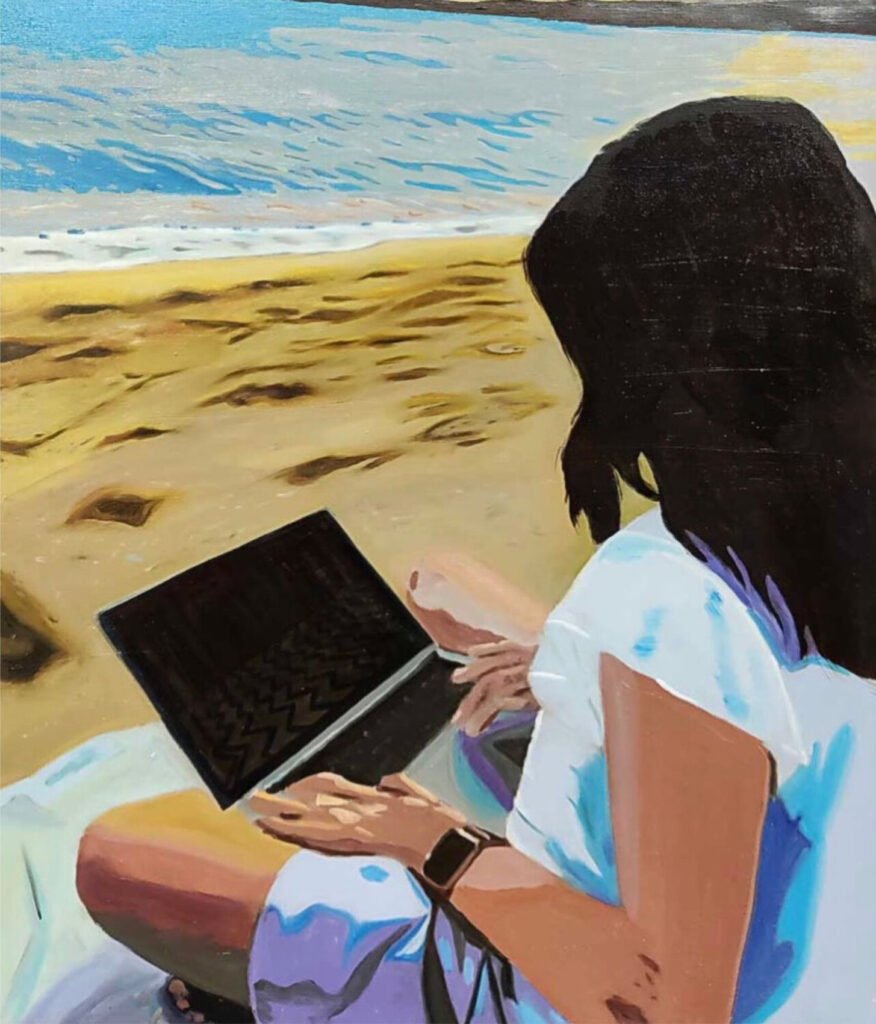
Another, possibly even more widespread thing that extremely clouds perception of a picture is the figurative trap. Suppose a picture depicts a woman sitting on the beach with an unfolded laptop—like the posted image in this blog; then many people will judge this motif as if it were a documentary photo: Aha, a woman on the beach, I’m interested or I’m not. And they overlook that the naturalistic aspect of reproduction, i.e., the photographic aspect, is actually the most uninteresting thing about painting. For it stands only for a certain often neurotically heightened degree of detail, which, however, need not have anything to do with the real gestalt of what is depicted. The opposite is often the case. For example, a pianist can be portrayed at a concert in such a way that every shade of the ivory-colored keys on the grand piano is naturalistic, shining in the spotlight of the stage, present, but you could just as well paint a picture in which the instrument consists of only a few strokes and it would still do much more justice to the music and the musician than any naturalistic fixation.
From this point of view, photography is by no means a higher development of painting, but rather a special case of it, in which extreme detail, which technology automatically provides every photo, replaces the often-missing eye for the essentials. Of course, there are also photos in which the true gestalt—of a human being for example—actually appears. But photographers with this eye are extremely rare; the vast majority of smartphone selfies are, in terms of painting, like quite inconsequential scribble.
To come to the gestalt, of which I write here as if it were perfectly clear what it means. Which, of course, is an imputation. Without becoming too philosophical now, by “gestalt”, here I mean the essence of an appearance. For example, the shape of a cherry tree definitely includes the pollinating bee, but not necessarily the supermarket’s advertisement for low-priced cherries. This weighting is debatable, but the point is: The worldview of the gestalt in any case implies the distinction between essential and inessential, whatever that may be concretely.
A distinction, however, that quite contradicts the present zeitgeist, since nowadays subjective feeling, a more or less completely arbitrary, self-centered perspective on the world, has experienced a kind of media canonization and replaced the perception of the real gestalt.
A recent example of this narcissistic neurosis has just occurred as a tragedy at the Yorkshire Wildlife Park in England: A young man jumped into the predator enclosure there, presumably because he wanted to take cool selfies. He was then killed when the tiger almost casually bit him in the neck and back. Not perceiving the gestalt—that a tiger is a dangerous predator and not a great cuddly kitten—is by no means a merely philosophical matter, but can be one of life and death.
In any case, if you take the element of the gestalt out of painting, it loses its special and unique meaning. Every smartphone is better suited for producing lifelike illustrations, and if you want to spice up your home decoratively, you can in principle hang anything on the wall whose motif or color pleases. This has nothing to do with painting.
The lack of a sense of gestalt now has not only to do with the conditioned blinders of the audience, but, logically, arises also on the creative side as a contemporary phenomenon of consciousness, i.e., among artists themselves. If a picture is without authentic gestalt, presenting itself only with visual stimuli or as a copy of bygone times, you can look at it with as much concentration and as long as you want and there will still be no spark, but ultimately only boredom.
Which reminds me of an anecdote about Dalí, who, when visiting an exhibition, praised the quality of the room’s heating pipes or well-plastered walls, but dismissed the pictures themselves with a disdainful shrug. Trash talk toward fellow artists has always been very popular, of course, and will undoubtedly remain so, but lack of gestalt of course makes it all the easier.
But there are also propitious examples. With which I come back to the picture posted on this blog, “Autonomo”, an oil on canvas by Ekaterina Quehl. In fact, I would never have written this blog without this picture, because I would have lacked any current inspiration for a text about painting. What is special for me about this picture—the rather simple motif of a woman on a sunny sea beach with a laptop, but with an aura of concentration and fusion with the environment—is that months before I had perceived exactly this aura, this gestalt, with my own eyes and completely independently from the picture. I sat on the Baltic Sea beach of Zingst and watched a young woman sitting down at the foot of the dunes above the beach in a light drizzle with a hood covering her head. She opened a book and began calmly reading. For me as an author, the fact that a teenager sat down and read on the beach in the drizzle beside the windy sea was an inspiring wink of fate asserting that literature is by no means dead and that it is really worth continuing to write.
The picture “Autonomo” is more likely set beside the Mediterranean, and instead of a book it presents an opened laptop. Not to mention what is probably an Apple Watch on the woman’s wrist, which makes it clear that we are already well into the 21st century. And that we are dealing with a person who is extremely exposed to the digital distractions of our time. But the picture’s gestalt of her concentration in the picture is extremely similar to what I saw at the Baltic Sea. Or in other words, looking at the picture now revives in my imagination the scene I experienced at the Baltic Sea. What does that mean? It is said that true gestalt, for example focus in harmony with nature, easily transcends space and time and everywhere produces elective kinships in which a similar gestalt appears.
This quality of a picture, namely, to mirror or even create gestalt, has not so much to do with the painting style, with techniques or materials. Which is an error made by art critics and academically influenced artists, who tend to overstate formal aspects. And who probably never will understand what Picasso meant when, at the age of eighty, when he was painting more and more pictures reminiscent of children’s drawings, he said that he now finally understand what painting really was. The exact quote may be different, but the meaning may not.
What this quality of gestalt has something to do with in painting and in all arts, however, is a true view of the world that has an open mind about what it sees. And as I see it, this is in line with the technically very unpretentious, but still contemporary character of Ekaterina Quehl’s picture “Autonomo”. And it made me aware again that painting need not be an outdated genre of art by any means even today, in the age of AI-generated images and hysterical scrolling on smartphones from one visual appeal to the next—on the contrary.