The sorceress Circe warned Odysseus about the sirens whose suggestive singing beguiled sailors to let their boats drive against the cliffs to drown in the shipwreck. So he had himself tied to the mast when they sailed past the island of the sirens, while the rest of the crew clogged their ears with beeswax to survive the life-threatening passage unscathed.
I have to think of this mythological fable now, and the reader will soon understand why – hint: smartphones – while I want to report on a little incident that reflects a typical conflict of our time in an atypical way. – As usual lately, I was doing yoga on my balcony. The sun had just risen. Unlike most other days, it was raining and thunderstorm clouds were rising on the horizon. But that didn’t bother me much. I had put on my swimming trunks and just had to be careful that I didn’t slip during the asanas, because neither my feet nor my hands had a good grip on the rain-soaked yoga mat. So while I was in the middle of my practice, the rain intensified and the sky directly above me grew ever darker; I could hear distant thunder, followed by blazes of lightning.
I was just in the “bow“ pose – “Dhanurasana” in the international yoga language – in which, lying on your stomach, you grab your ankles and bend upward just like a bow, so that your belly button supports and balances practically your whole body. Instead of fixing my gaze on the tip of my nose, the classic, focusing point of view in this asana, I stared into the sky above me: it had suddenly become as dark as night, and the crashing thunder was no longer distant, but close and made me shudder. The lightning also no longer illuminated the horizon, but the buildings of the surrounding block.
I now had two thoughts: one was a bit anxious, but very reasonable: despite all the lightning rods and the fact that my balcony was only on the second upper floor and not on the roof, lightning bolts, as meteorological strokes of fate, often find the strangest ways to abruptly end the lives of the incautious. On the other hand, literary authors are not particularly reasonable people – otherwise they would have become screenwriters or advertising copywriters or journalists – and so this thought was rather a kind of dutiful assessment of reality without practical significance.
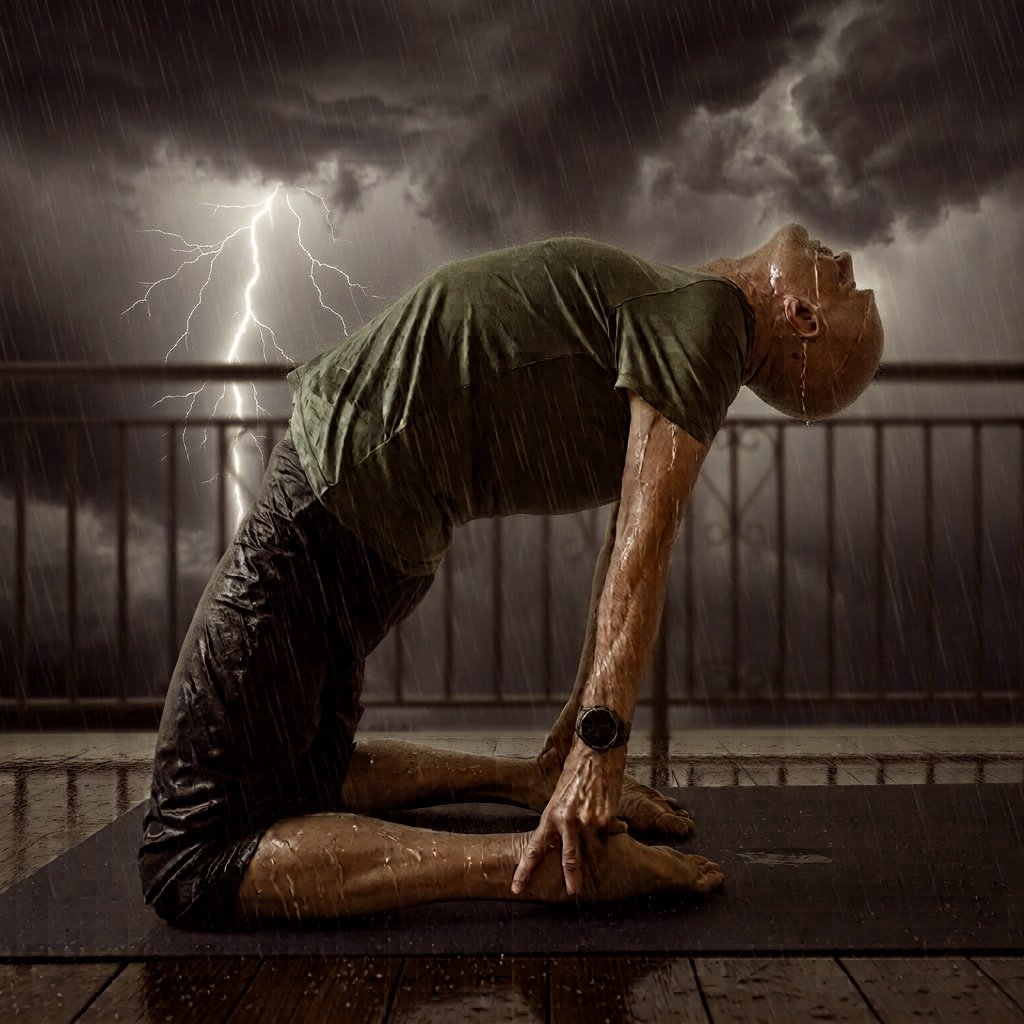
The second thought, however, went much deeper: I immediately realized that practicing yoga outside in a thunderstorm would make a brilliant photo motif. Before my inner eye, I saw myself practicing an asana illuminated by a Zeus-like lightning in the pelting rain. And since I was just practicing the second series of Ashtanga yoga – many back bends – the next pose after the “bow” would be the “camel.” A posture in which you bend backward with the upper body with your knees on the ground, grab your heels with your hands, thereby open wide your chest, and present yourself defenselessly to the sky, which in this case was approaching me directly with lightning and thunder. Breathing calmly in such a situation, keeping the yoga pose relaxed but also stable would be the ultimate coolness, the ultimate yoga, the ultimate calm in the almost proverbial eye of the hurricane.
For such a photo, however, I would have abandoned the situation, gone from the balcony into the apartment, and then, returning to the storm, would have had to fiddle with my smartphone for a while to be able to take a usable selfie. All these actions, driven by photographic or even video documentation, would fundamentally distort the current situation. Because the moment I left the balcony to grab my smartphone, the magic of the moment would be immediately gone, since I would no longer experience precisely this moment, but would be primarily driven by the impulse to document it. Which would change it qualitatively.
Just as electrons in the well-known quantum experiment, if measured, i.e., “observed”, no longer behave like a wave when they are sent through a double gap, but suddenly show the properties of particles. This seems very paradoxical, but is now thoroughly proven as a physical fact. Especially in our times driven by visual “posting”, i.e., filming and photographing, this fact seems to me to be worth mentioning again and again: observation changes what has been observed.
But back to the balcony, because this is about a specific case and not general wisdom: so while I remained in the bow pose and the raindrops gently massaged my back, I had to decide: for the moment or for the smartphone, for the experience or for the posting, for the introverted experience or for the extroverted show.
I wasn’t particularly photo-savvy in pre-digital times; I have always felt that the influence of the camera in private situations distorts the true situation and I often found it quite annoying – professional filming was a very different story, of course. But I was greatly tempted to run for my smartphone to shoot a cool picture. Contemporary times had not passed my soul without a trace. All the world posted continuously. Which, of course, also had to do with the fact that a picture actually said much more than many words. As long as they were documentary snapshots. But as seductive as the impulse was, I ultimately did not want to sacrifice the cool situation for a cool photo, and so I decided with an inner jolt – this psychological process lasted at most a few seconds, but was very complex – to forget the smartphone and any visual media exploitation and instead to remain uncompromisingly in the present.
A decision that was immediately rewarded with a friendly wink from fate. For while I moved into the next pose of the Ashtanga sequence in the pouring rain – the “camel” or in the usual yoga terminology in Sanskrit: “Ustrasana” – and took my first deep breaths and stretched my chest toward the dark, almost black sky, a flash suddenly lit up the sky in a reddish hue. I stared in close-up; the bolt actually seemed only a stone’s throw away, in the center of this natural phenomenon and immediately relativizing everything human. A bloodcurdling clap of thunder swiftly followed. (For those who have forgotten what they learned in school: light is faster than sound, so you hear the thunder later, even though it takes place at the same time). But my breath remained deep and calm, astonishingly unimpressed by the spectacle. As strange as it may sound, I felt for a fleeting moment intimately and fearlessly connected with the lightning, thunder, and gloomy sky. As if they were part of me and I part of them.
This moment passed as quickly as it had come; and the rain also became weaker and everyday life captured me again in the sense that the mystical aura evaporated and in the asanas I became aware again of my swimming trunks sticking wetly to me and of the slippery mat. The rest of my yoga practice again seemed more like business as usual.
But the crassly transcendent moment in which my ego literally lost itself in heaven, or even, vice versa, in which the sky presenting the incomprehensible universe spread visually in me, had taken place; and only because I had not yielded to the temptation to run to my smartphone and take selfies. I would not have been in the “camel“ pose, opening my body and psyche in the face of lightning, if I had attended to documentation instead of experiencing the situation. Above all, I certainly would not have felt it so intensely and not literally opened myself with my whole body to the heavens of nature and also a little bit of the hell of transience. I would probably have experienced the idea instead – and then shared it with video or photo evidence – to do yoga in the storm, but by no means the authentic reality of it. Which is a huge difference.
The result would then have been the media-manipulated idea of the moment instead of its authentic experience, and with this I swerve again to the sirens I began with: today their distracting singing takes, among other things, the shape of smartphones and is no less life-threatening than in Homer’s times, because they distort the perception of the present.
For mythological fables, of course, are never to be taken literally; instead, they always represent an essential aspect of the human psyche. Those modern people who sniff at the classical myths – because their protagonists, in the face of manipulatively suggestive singing from a sea island, do not simply board a plane or play other music via Bluetooth headphones, instead of primitively clogging their ears with beeswax – have not understood the essence of the myths, which collectively represent psychic and not currently literal realities.
Distraction from one’s own present is such a psychic, general human reality, whose contemporary expression is no longer a beguiling voice driving naive seafarers to ruin; modern sirens present themselves as smartphones. Their potential to distract, at least as long as the battery holds, is inexhaustible: today, it is conceivable in any situation that someone reaches for his mobile phone and exchanges the respective present for a digitally sexed-up version and thus essentially distorts.
Even such a rare situation as doing yoga outside in the thunderstorm would have mutated downright cancerously in its core if I had succumbed to the temptation of the smartphone. Even someone like me, who is relatively resistant to the virtual sham worlds that constantly flare up, would still have almost succumbed to this psychic mirage.
All of this is, of course, not a criticism of modern technology and communication. Instead, it is an indication that the old myths have by no means become meaningless, but merely return in a new and contemporary form. If smartphones are the sirens of the present and can virtually confuse people’s spirits and dissuade them from their authentic ways and beings, then, accordingly, characters are also needed again who resemble the clear-sighted Odysseus or the wise sorceress Circe; when the myth raises its real head, then political bloviators, neurotic snowflakes, and religious fanatics are also corrected to their true, to their human proportions. Which is a good, a socially healing thing.
In other words, even in the age of smartphones, archetypal conflicts simmer in our psyches. The case described here, yoga on the balcony in severe weather, is about the decision between focus or scattering. Conflicts that no artificial intelligence will be able to solve, but only true human self-perception. Which is the essence of yoga, as I understand it. Thus, it was not the execution of the camel pose in lightning and thunder that was the hallmark of yoga, but the fact that for a moment I accepted and perceived the storm completely calmly and without subjective contamination. Without the pose, however, I would probably never have felt this calmness and clarity.
Apparently, the things of the world are intertwined in a very mysterious way: the corporeal needs the spiritual, and vice versa; the simple the complex, and vice versa; the present the past, and vice versa; and in this sense, artificial intelligence, smartphones, virtual sham worlds are also indispensable, since without them the world theater would have neither stage nor props and there would be no acting at all. Which would be a pity.
P.S.
By the way, this blog’s posted image is obviously strikingly AI-generated. It illustrates this text as an eyecatcher, which is a wonderful thing. It does not replace the text,
but confirms it: the sham world is also part of the world.