
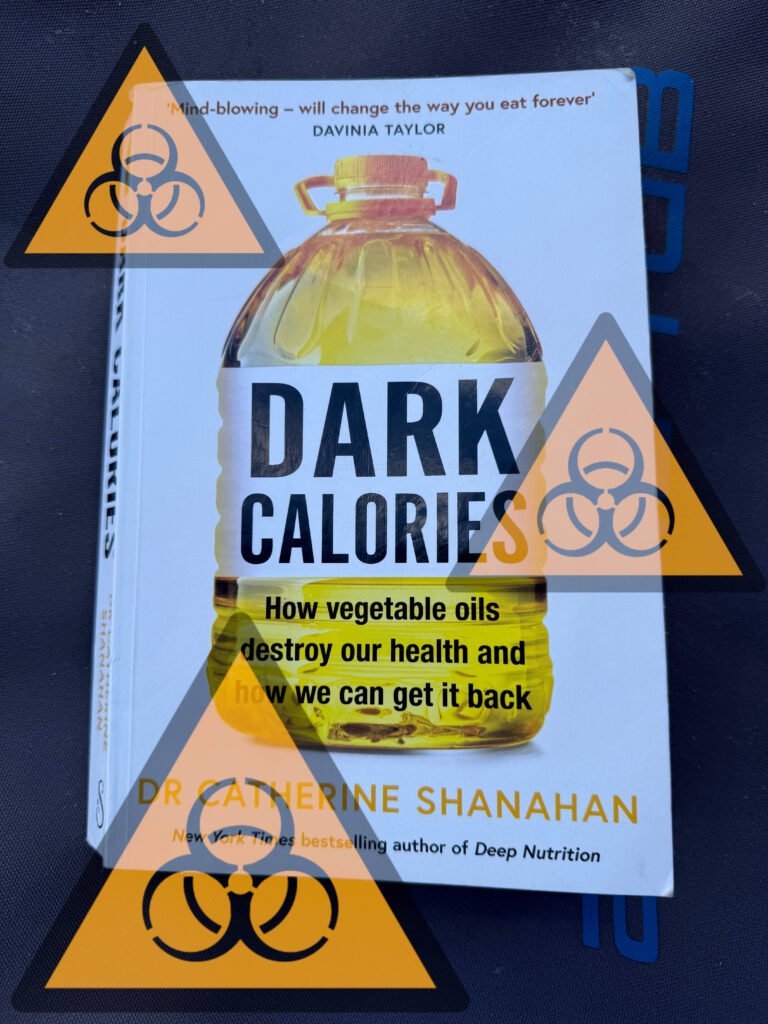
First of all: What particularly qualifies me for a review of a nutrition book, where chemistry and medicine are not neglected, is that I am not particularly qualified at all. If one is not deterred by diagrams, footnotes, and statistics, “Dark Calories” by Dr. Cate Shanahan is quite generally understandable and is not only aimed at experts, but also to interested laymen.
Those are people who read with a certain naivety by first trying to understand the thesis of a nonfiction book, instead of immediately evaluating it from a professional perspective, which of course professionals do almost automatically. So I am more or less unencumbered by nutritional prejudices or beliefs and therefore do not immediately mentally shrug it off if, for example, the author argumentatively clearly rejects the alleged harmfulness of foods containing cholesterol, such as butter, eggs, organ and other meats, and so on. I understand the logic behind it.
I try to mirror the content of a rather complex and possibly very important book in a generally understandable way. Not as a scientist, which I am not, but as an author who is trained in perceiving texts in all their details holographically, as it were. By which I mean that I also react to the consciousness shimmering between the lines, to the form of a text that is always more than the sum of its parts. Some texts, including sober nonfiction books, can have an aura that feeds from such emotions as compassion. This is hard to describe exactly, but still perceptible when reading.
So I am present here more as an unbiased eyewitness to a book, not a critical reviewer. I have to say this from the beginning, because of course trained scientists have a different perspective than literary authors. I don’t want to presume competence where I don’t have any. But reading and understanding texts of all kinds – I can do that quite well.
Anyone who has an Internet connection today or who used to consume such pre-digital mass media as newspapers and television, and who is at least interested in the real world from the corner of his eye, should know the phenomenon: over the years and decades, substances have repeatedly come to public attention and have been demonized as severely harmful to health. Whether electro-smog or alcohol, asbestos or sugar, car exhaust or cows producing too much methane by farting. Not to forget carbon dioxide (CO2) as a “climate killer” and doomsday accelerator. Religious or other fanatics add to this potentially infinite spectrum such “forbidden” ingredients as pork or ethically “toxic” foods, for example, meat and fish in general.
Such warning lists of horror can be produced almost at will according to personal or political taste, since they are rarely if at all verifiable for the layman in everyday life. Which, of course, is also the essence of their charm for their producers. Claims about harmfulness are sufficient, assuming a minimum of plausibility. An uninterrupted stream of dangerous or pseudo-dangerous, in any case often practically unavoidable molecules accompanies modern man on his mostly chaotic journey through life like a mosquito swarm in the Finnish summer.
As a contemporary, of course, you grow dull in this permanent medial bombardment: life ends at some point anyway, whether through too much beer or too much bread does not matter – and you comfort yourself with the old wisdom of Paracelsus: ultimately, the dose makes the poison. So: Who cares?! It’s not gonna be that bad.
In fact, because of Paracelsus and his broadly recognized realization that the dose actually makes the poison, one should pay great attention to Cate Shanahan’s book “Dark Calories”. Because she places at the center of her book an ingredient that, at first glance, is harmless and that often shimmers golden-yellow in bottles, quite wholesomely and often amicably. This item can be found on the ingredient lists on virtually every shelf in any supermarket, whether organic or not: vegetable oil. (Specifically called “polyunsaturated” oils: on this chemical aspect later). Whether in fish sticks or potato chips, in dried fruit or sardine cans, in gummy bears or in mayonnaise, you can really find in the small print either rapeseed oil (also called canola oil) or sunflower oil or soybean oil or five others, which the author calls the “hateful eight”.
Anyone who, in the face of this dark word, feels reminded of a lawless gang from a classic Western that terrorizes a peace-loving population with murder, rape, and robbery is on the right track. I’ll get to that in a moment. But we are not dealing with a manageable band of villains, but as it were with a whole army of zombies.
Vegetable oil is so ubiquitously present in our diet, mixed into food, whether in restaurants or at home, whether in the supermarket or as snacks at gas stations, that now a good 30 percent of our total calories per day can come from unsaturated vegetable oils. Often practically invisibly integrated into many industrially produced food products, recognizable only on the ingredient lists in very small print. These vegetable oils used everywhere can’t be tasted any more than you can feel radioactivity.
Which has to do with the production process of these oils. One of the many necessary steps to obtain human-edible oil, for example from hard sunflower seeds, is deodorization, i.e., odor removal, in addition to all possible filtering of hazardous substances that are produced during pressing and heating, because otherwise no one would buy industrially obtained sunflower oil. It would smell god-awful, like mothballs, among other things.
But that’s a comparatively harmless aspect. First of all, it is important to perceive that vegetable oils in the modern world do not have a niche existence that can be easily avoided. If they are really harmful to health on many levels, as Dr. Cate Shanahan maintains in her book, then humanity has a real problem that you can’t simply ignore. Especially not in restaurants or at home with daily food. Or snacking. Or at the Asian snack bar. Or with currywurst and fries. Nowhere, actually, because as an ingredient, vegetable oil is everywhere in our food.
If industrially produced vegetable oil (actually, of course, vegetable seed oil) is harmful, even extremely harmful, then Paracelsus’s saying that the dose makes the poison is no all-clear signal, but a shrill warning, at least for the health-conscious.
Now this gets a bit chemically involved, but as a layman I have the advantage that I can reproduce a scientific fact in simple terms as I understand it. About as carefree as if I were sketching a cooking recipe or the theory of relativity in the pub on a beer coaster.
And that’s what I’ll do now. Real connoisseurs of the topic may forgive my simplicity: polyunsaturated vegetable oils, for example rapeseed oil, with which many mix their salad dressings, react extremely strongly with oxygen on the invisible but real level of the molecules, so they oxidize easily; which means two things that are bad for health. On the one hand, during production, the oils themselves unavoidably form a toxic cocktail full of pollutants for humans. And on the other hand, and this is the real drama, when vegetable oil comes into contact with human cells and oxygen, which it naturally does during food intake, because the blood transports oxygen, the body cells in question are then also exposed to this chemical reaction, i.e., the infamous “oxidative stress”. You can imagine this as being like a burn of the skin or like a forest fire, just at the cellular level.
This oxidation in the interior of the body, initiated by vegetable oil – similar to how the ignition spark starts a combustion engine – also continues as a chain reaction until it is stopped by the body’s own antioxidants. Or by completely destroying the cells. Which is not only interesting on the microscopic level and for chemistry freaks. On the contrary, according to current scientific research, all degenerative diseases not caused by viruses, germs, and physical trauma are traceable to “oxidative stress”, which ultimately leads to cell destruction. Alzheimer’s, cancer, heart attacks, type 2 diabetes, the list is endless and is detailed in the book.
Classic oils already used in the kitchens of the world for thousands of years such as olive oil, coconut oil, peanut oil, and some others are exempt from this dark scenario. First, because they are chemically “mono-unsaturated”, which means that they do not react as aggressively with oxygen on the molecular level as the polyunsaturated vegetable oils. And second, practically easy to understand: olives or peanuts can be squeezed out much more easily, without much chemically destructive effort, because they are softer than sunflower seeds, for example. Butter, lard, and tallow, by the way, i.e., the often-demonized animal fats, full of cholesterol, are chemically called “saturated” in this context, hardly react with oxygen. And are therefore practically totally harmless with regard to “oxidative stress”.
Translated into practice: butter on sourdough bread does not attack the arteries, margarine (from vegetable oil) destroys them by oxidative chain reactions. This thesis alone is already an absolute medical sensation, since it calls into question the globally prevailing narrative, spread by many GPs like a mantra, that animal fats containing cholesterol are harmful to health and in particular cause heart attacks. A lot speaks for her thesis.
This, of course, is only a subjectively edited trailer of the book’s content. In the book’s first part, both the industrial production of vegetable oils is presented in detail and their harmfulness for human health is shown in detail. Even those who have no knowledge of chemistry or human medicine can follow the explanations. The author has the pleasing gift of presenting scientifically complex relationships in a generally understandable way. Of course, as a reader, you have to concentrate in order to follow. Your attention span should therefore extend beyond the duration of a promotional clip on YouTube. But then you are rewarded with real understanding.
The second part asks how it could have come to this?! Because these specific (“hateful”) industrial vegetable oils entered humanity’s menu only at about the beginning of the twentieth century. And were not initially accepted at all. American housewives, it is documented, left the stuff on the shelves, even though it was cheaper than butter. It literally stank too much; at the beginning of the twentieth century, deodorization was not yet as perfected as it is today; the distrust-inspiring smell of these industrially produced oils was still perceptible via the nose. And of course, there was no Internet, no opinion-manipulating, pseudo-intelligent computer oracles; at least in regard to their diet, people probably trusted their instincts a little more than today.
Before I come to Cate Shanahan’s plausible explanation why the classic fats and thus cholesterol were suddenly demonized and the vegetable oils began their global triumph as bringers of salvation, a short meditative pause. Because at first glance, the story is more reminiscent of an international thriller than of a sober historical inventory. Screenwriters should be thrilled. Which, in turn, could tempt skeptical people to view the whole vegetable oil warning as staged and exaggerated. Therefore, the reason why industrial polyunsaturated vegetable oils have spread in the global diet does not change the assessment of their possible harmfulness, so in case of doubt it can be seen independently.
Current healing and historical research on causes ultimately come together logically and naturally, but in order to be fit for the present, one should not confuse things. There is a famous parable of Buddha: whoever has been hit by a poisoned arrow should first take it out and treat the wound. If he (generic masculinum, women can of course also be hit by likeminded Zen arrows) instead thinks too long about the material of the arrow, the type of poison, or the possible archer, he simply dies. Which would gain nothing.
However, the author has already pulled out the arrow by naming the evil: vegetable oil causes oxidative stress. In this respect, her persuasive explanation of the cause of this alleged dietary disaster is a bonus.
I understood the quite exciting story that made vegetable oils such a global player, as follows: (My words are a retold sketch, so without guarantee; in the book it is presented much more documentarily and with greater nuance.) Shortly after World War II, people in the USA began eating significantly more meat again. More and more animals had to be fed. They were fattened with soybeans. However, the oil had to be removed from these, because the pigs and cattle did not tolerate it, but only the flour. The animal feed producers now had tons of extracted oil: but what could profitably be done with it? So they came up with the economically logical idea of making it usable: they refined it until it was suitable for human consumption. But that didn’t lead to people buying it with enthusiasm.
Someone from the advertising industry at the time, however, came up with a brilliant idea: If you can convincingly present something to the population as wholesome, they will buy it. So the vegetable oil company sponsored the then financially quite meagerly positioned “American Heart Association”, which comprised physicians who mainly dealt with the increasing incidence of heart disease. It was such a massive financial injection that this association (“AHA”) could suddenly carry out advertising and influence on a large scale: dietary guidelines for schools, universities, for example, but also for the population as a whole.
And, this is now the devilish plot point, so to speak: this officially highly respected association, which dominates the medical profession, suddenly drummed into orchestral strength for the health benefits of vegetable oils – because who pays the piper calls the tune – especially for the prevention of heart disease, without any actual scientifically valid evidence, i.e., serious “double-blind” studies for this claim.
In parallel in the same breath and dubiously without authentic evidence, cholesterol was claimed to be harmful. In terms of competition, this was quite logical, since butter for roasting, for example, was and is a direct competitor product of the hyped vegetable oils. Butter would allegedly clog the arteries and cause heart attacks, much like food scraps can clog the kitchen sink’s drains. While vegetable oils, golden and supple, would supposedly take their healing paths through the human body. These were memorable images that have spread internationally to this day, among both lay people and physicians.
But Cate Shanahan puts her examining finger on this scientific wound: when viewed by sober daylight, the devaluation of and scaremongering because of cholesterol is apparently absolute nonsense. If you want to know more in detail, you must of course read the book; to illuminate such details in more detail is beyond the scope of this blog. The point is: according to the author, medicine was long ago hijacked by the vegetable oil industry and still sails under its flag today. Possibly even in good faith.
A daring thesis, but it at least explains why, despite the apparent complete lack of studies showing that cholesterol is harmful, vegetable oil still plays such a dominant role in nutrition on a global scale. Although the oxidative health-damaging consequences of the consumption of polyunsaturated fats are relatively clearly proven by toxicologists and fat scientists (lipidologists, such occupations actually exist), the public pays little attention to them. For the layman, the critical voices from science are hardly accessible, often too chemically involved, and not entertaining enough; and usually GPs, AI, and the media advocate for the consumption of vegetable oils.
The mind of the unbiased reader, of course, is a-buzz in all this. Not only do you get a crash course in medicine served on the cell level, you also lose faith in the official nutrition guidelines and of course also automatically in the doctors who represent them in blind belief.
However, there is good news. This is the third part of the book. There, step by step, if you have accepted the theoretical part, it shows you, practically and in the here and now, how to free yourself from vegetable oils, what ingredients you can use, and how to combine cooking and shopping and health under these new conditions. There is even a “2-Week Challenge” with which you can escape the hamster wheel of the ubiquitous vegetable oils from breakfast to lunch to dinner, with suitable ingredients and quantities for two weeks. Even those who cannot cook – and those who can will learn new tips and tricks – will find a very practical guide to go through life in a diet-conscious way, without getting bored at the table.
However, the significance of this third part in the context of the book is less in the concrete details, because these are quite flexible except for the avoidance of vegetable oils and the reduction of highly processed foods such as pasta. So it is not about individual recipes, but about the fact that it is at least in principle possible to eat wholesomely nowadays.
Which means to be able to break out of the prison of the health industry, where, once landed as a patient, you usually can hardly get out.
However, if you change your diet, especially by deliberately avoiding polyunsaturated and industrially produced vegetable oils that are present everywhere, there is suddenly a good chance of getting and staying healthy. Because one is no longer at the mercy of the vicious circle of oxidative stress on the cellular level and therefore of a constant drug supply from the pharmacy.
As a chemical and medical layman, of course, I can’t really judge whether oxidative stress and thus human cell destruction takes place on a large scale because of these vegetable oils. But the reasoning seems very logical and understandable to me. As an author, even if English is by no means my native language, I can still feel a spiritual energy in the language of the book, which arises only when someone is deep in his or her material, no matter which it is. This energy, which eludes description, but not inner perception, cannot possibly be faked. It’s like “It don’t mean a thing, if it ain’t got that swing.”
Those who are interested in nutrition in the present, and who prefer facts over ideology, can’t avoid “Dark Calories” either way. It is a shocking goldmine of insights that this blog cannot replace, but which it can draw attention to.