Despite all the bright smartphones in everyone’s hands and the always-on of the Internet, Germany lives in large part in the deepest Middle Ages, that is, in unconsciousness about itself . Where, at least psychologically, the devil is still painted on the wall, witches are burned, and a media inquisition that considers itself infallible engages in its mischief.
There is little difference between the mainstream “anti-fascist consciousness”, for which AfD members and all those who, for example, consider unregulated migration to be a catastrophic destruction of their own culture, are considered “Nazis”, on the one hand, and hardcore Muslims, for whom women and infidels – not to forget dogs – are inferior, on the other.
On a first and/or superficial glance, such different representatives of different human cultures – some stone their victims literally, the others at the moment still prefer verbal and digital slurs – are united in that they have a clear image of an enemy in their know-it-all souls. Those who belong either to the “infidels” or the “right-wingers” attract a contempt and hatred that cannot be explained rationally, that is, causally and humanly comprehensibly.
Most non-Muslims have never hurt any Muslim and the vast majority of AfD members or sympathizers are completely normal contemporaries without any criminal, much less “National Socialist” (“Nazi”) background. Quite the opposite. And yet: the roaring voices of concertgoers who, animated by so-called musicians on stage, scream: “All of Berlin hates the AfD!”; or Islam, the alleged “religion of peace”, “inspiring” a man to brutally act out by driving full speed into a crowd, thereby crippling or killing random passers-by. This brutal psychic energy, whether isolated or in a mass, is an underestimated and usually completely misunderstood reality.
I am consciously speaking about psychic energy and not a political “attitude” or the like. For the error to which many are naively subject is that aggressive political or religious directions are at all interested in a reasonably communicative and respectful exchange of opinions and arguments. They’re not. Usually not even out of calculated malicious intent, by the way, but because rationality no longer plays a role at all in an emergency, when unconscious psychological processes have taken control.
In private life, everyone knows what it means when someone temporarily flips out, whether out of panic or anger, and is under the thumb of an obsessive idea and communicatively no longer reachable, at least at the moment. What can take place in isolation in the individual can of course also be a phenomenon on a larger, social scale. And this often generates an irresistibly powerful pull by group dynamic emotional pressure – most recently perceptible on a global scale in the corona hysteria. A mass of people can “go off the deep end”, i.e., losing the sobriety of common sense and thus also all humor, because, for example, a media-stoked emotion such as fear or aversion spreads like an avalanche in the psyches of the individual. Then authentic communication has become impossible on the level of consciousness.
This is of course nothing new; classically educated people may think of the saying from ancient Rome: “Senatores boni viri, senatus autem bestia” (“The senators are good men, but the Senate is a beast”). In general, those who read could associate Le Bon and his book “The Psychology of the Masses”, which analyzes the psychological time bombs of social groups or entire populations that can go off at any time due to manipulation. And depth psychologically, there is no way to ignore C. G. Jung, who devoted his entire life and writing to the exploration of these unconscious psychic processes – because he realized their dominant effects on the life of individuals and on society as a whole.
Thus, although the susceptibility of human consciousness to overwhelming emotions rooted in the unconscious is very old hat, confronting this problem is repeatedly and unfortunately a very current matter. The aura of civilizational enlightenment, of coolness and intelligence, which the cultural mainstream at least implicitly claims for itself – explicitly spoken, the discrepance from reality would be too obvious – is, soberly considered, a complete deception. As an example of this, I would like to mention the public perception and presentation of Björn Höcke, state chairman of the AfD in Thuringia, which many media and Internet platforms have stylized as a nationalist and inhuman devil in human form, as a barely concealed revenant of Hitler, full of megalomania, racism, and hatred.
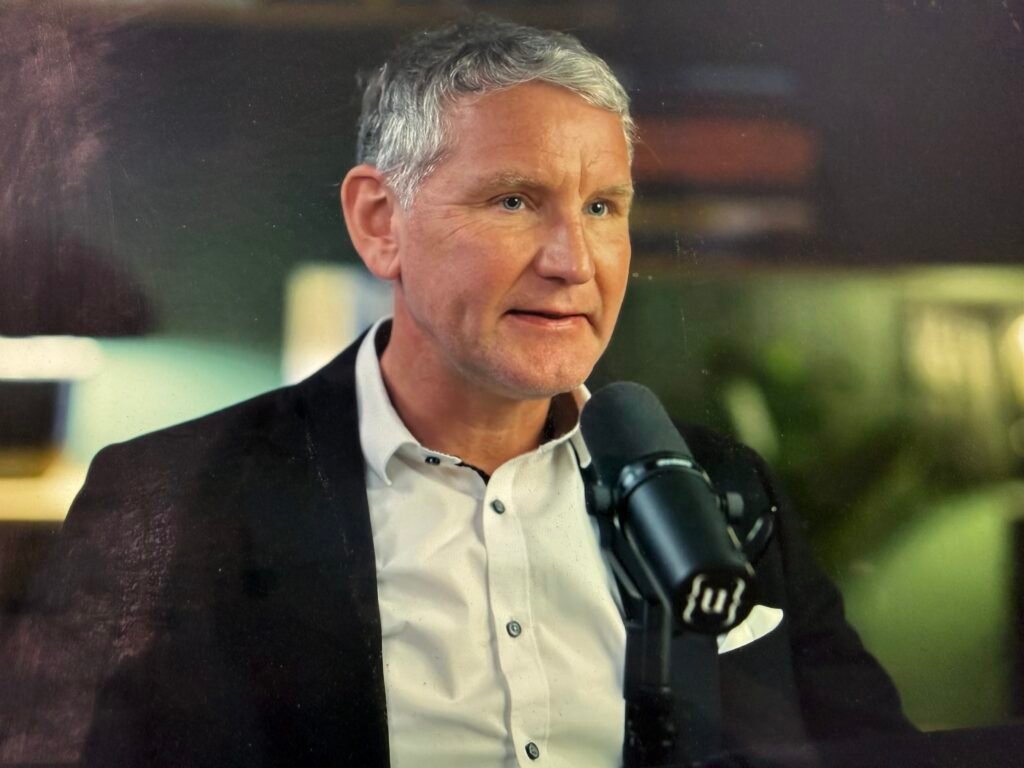
Before I come to the interview with the podcaster Ben (link here), which had millions of views and likes and positive comments within a few days a few weeks ago, and in which Björn Höcke presented himself and his political attitude in conversation for four hours, without constant interruption and insults, but on a human level – let me insert a small personal remark.
My position is worldly, but unlike most people’s: practically from childhood, I have been deeply immunized against political ideology, which purrs on autopilot. As a boy, I grew up in a commune for a few years, where the first generation of the RAF terrorists routinely showed up and left again; people whom public perception soon classified as dangerous terrorists. Since I had a gift for board games early on, I often sat with Jan Raspe at Go or with Philip Sauber at chess. The former later shot himself in Stammheim, the second was killed in a gunfight with the police.
Why am I telling this? Because it helps explain my different view of politics. I can remember, for example, Jan’s sunken, concentrated face as he stared at the go board when I had made a good move. This introverted, meditative face had nothing to do with the demonic crime photos that would soon fill the newspapers and television.
This experience that media paints a distorted image of people unconsciously took root in me in such a way that I never again took public opinion for authoritative. Second, and this is even more immunizing against ideology: I lived in the middle of a pro forma leftist environment, but I was instinctively repulsed by the violence that politically motivated terrorists, including Jan and Philip, consciously accepted as unavoidably including collateral damage – the deaths of random people like chauffeurs or police officers – during assassinations or abductions.
This means, and this is now the general punchline and essence of my point of view even today: I was and am not at home either in the so-called left- or so-called right-wing milieu, but where the individual counts. Experienced reality is the true test for every opinion, and not only imagined and exaggerated models of the world cloud consciousness.
In other, simpler words: I have a deep aversion to any kind of ideological manipulation. With this attitude, I watched the podcast with Björn Höcke. And honestly, my first and last impression was that of a free, very reflected mind. Of course, I can’t and don’t want to discuss a podcast of over four hours in detail here.
But the main line of Höcke’s argument specifically on migration policy and the Pavlovian reflexes of revulsion in the ruling mainstream is basically quite simple and understandable: every country has a cultural identity, difficult to define, but clearly mirrored in its language and customs. And if it wants to preserve itself in this grown structure, which is the right of every nation, then it must control immigration at its own discretion. And not everyone can have German citizenship including total social care. This is neither racism nor xenophobia, but the pure instinct for self-preservation of a nation that takes itself seriously.
That is actually a downright banal necessity; in his private life, even the most avid multiculturalist immediately takes it into account when he does not simply give the key to his apartment or villa to anyone who asks for it. Privately, all these so-called cosmopolitan people are the most anxious and concerned about their own safety. Which is why, of course, they unconsciously want to open to everyone the borders, but not their own front doors. Practical depth psychology. In any case, I have not heard of any current top politician who sends his children to school in Berlin-Neukölln or shares his beautiful house with “refugees”.
But it casts a shocking light on the current culture that consciously protecting one’s own borders is perceived and presented as “nationalist” or “far-right” or even as a harbinger of a new fascism. And that seeing someone like Höcke as a racist and backward demon, when, like a modern Indian, he basically wants to preserve only the sovereignty and traditions of his people, is a nasty distortion of his persona and his political attitude, both of which are, soberly considered, quite rational and liberal.
Of course, one can also express a completely different opinion: for example, that Germany should disappear as a nation, become a melting pot, something completely different – through a “great transformation” or whatever the inflated words are in the face of inhospitable reality. But if democracy is serious as a form of government, voices must also be allowed from people who do not agree with that and are articulate that difference: persons who regard their country as their homeland and worthy of protection, who therefore also apply to it the internationally recognized right of self-determination. In the case of Germany, this means that calling such a stance “fascist” is so obviously nonsense that it is amazing that anyone could ever put this idea into the world.
But it has happened. A historical reminder: Hitler wanted to dominate and enslave the world and not, like the AfD, for example, simply to live as a sovereign state in peace with its neighbors.
In any case, the media demonization of Björn Höcke is not comprehensible on a rational level, but it is psychologically explainable. People like to project their own repressed and unlived sides onto the image of an enemy. In the Jungian sense, this is a collective archetype of unconscious behavior. Sometimes witches are the scapegoat, sometimes Jews, sometimes the so-called “right”. Because with a publicly identified but ultimately projected evildoer, people do not have to change themselves, but can blame others, for every evil in their private lives and in the world as a whole.
This is convenient, especially in the collective variant. One simply belongs automatically to the “good guys” and saints by adopting the prevailing public opinion, without ever having to have done anything good, much less sacred. This is a very favorable bargain for self-esteem that the typical blind or blinded follower can hardly pass up – and thus they are ready, sooner or later, to strike.
In any case, to understand why Björn Höcke has to be surrounded with more bodyguards in today’s so-called democratic Germany than any previous chancellor of Germany, or why every Christmas market in winter reminds us of a military fortress, one urgently also has to deal with psychology.
Especially with depth psychology. And this is dramatic in that social consciousness is underdeveloped. As long as in interest in the underlying causes of what bothers people, i.e., a glimpse into the cellars of human souls, is regarded as “soft skills” or even as a waste of time, little is likely to change in the unconscious and destructive obsessions of fanatical contemporaries and their respective political and/or religious movements.
This question from C. G. Jung in an interview was very serious. He had in mind nuclear war, for example, as a consequence when psychological explosiveness spreads en masse through the population. His question has never been truly understood or answered by the cultural mainstream, to this day. Many still dismiss him today as an esoteric crackpot. But he was a sober realist in his own way. To call this into consciousness, and to focus, however imperfectly, on the hidden psychological factor of social conflicts is the spiritual horizon of this blog post.